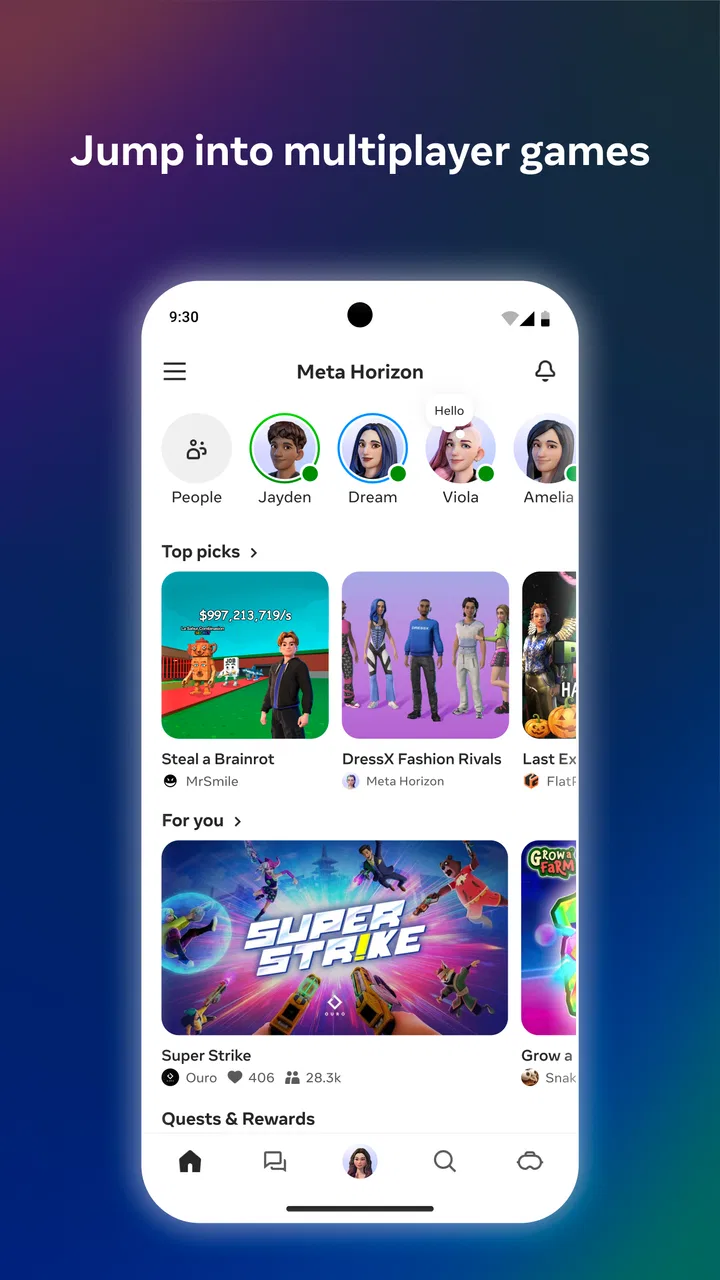
Meta Horizon
- 4.5
- Rating
- 10.00M
- Installs
- Free
- Price

 Analysis by App-foxy
I approached Meta Horizon as an adventure game first, but its real character is broader than a conventional game you open, finish, and put away. It is built around stepping into changing experiences, which makes the quality of navigation, the clarity of on-screen information, and the comfort of the surrounding context just as important as the entertainment itself. After spending time with it, I see a free entry point that can suit curious players who enjoy variety, while also demanding more patience from anyone who needs a very controlled, predictable interface.
The game comes from Meta Platforms Inc and is available for players aged Teen. It has reached over ten million installs and holds a 4.5 average from roughly 109 thousand ratings, so it is clearly not a niche experiment. Still, popularity does not automatically make an experience comfortable for every player. My recommendation depends less on whether you like adventure games in general and more on how well you handle changing visual information, online-style environments, and a product whose appeal is tied to exploring what it offers rather than following one simple campaign.
How clearly the experience guides different players
I find that the experience’s open-ended format asks different players to make different kinds of decisions: some will enjoy choosing a direction, while others may benefit from taking time to learn the layout before exploring. In this section, I look at how that flexibility affects readability, navigation, and comfort, then consider practical ways to make a session easier to manage.
You May Also Like

 Blood Strike: 2.5 Anniversary
Blood Strike’s Loadouts Turn Every Drop Into a Tactical Gamble
A close look at Blood Strike’s custom loadouts: how fast access to signature weapons reshapes its battle royale rhythm, rewards preparation, and narrows the gap between fights.

 Pandora - Music & Podcasts
Pandora’s Music Is Easy to Start, but Harder to Recover
Pandora’s strength is its low-effort path from a seed to a station. Its weak spot is how much confidence it asks you to place in connection, setup, and quiet recovery.

 8 Ball Pool
 Is Built on Rivalries, Rematches, and Routine
A close look at the rivalries, rematches, shared routines, and unanswered safety questions that turn a quick pool match into a persistent mobile community.

 Samsung Music
’s Quiet Strength Is Playing What You Already Own
Its reach comes less from spectacle than from dependable access to a personal library. That simplicity is both the app’s strongest retention engine and its ceiling.

 AccuWeather: Weather Radar
AccuWeather Review: A Quick, Clear Forecast for Everyday Decisions
For everyday plans, the best forecast is the one you can understand quickly. AccuWeather makes rain timing, radar, and local conditions easy to act on, with a few trade-offs.

 Hill Climb Racing
Why Hill Climb Racing Still Turns Crashes Into One More Run
A tiny car, a bumpy hill and one more upgrade: Hill Climb Racing keeps resurfacing because its simple chaos makes every near-miss feel personal.
More From Our News Desk



Readability and navigation in everyday use
The first thing I noticed is that the experience asks me to orient myself before I can enjoy it. That is normal for an adventure title, but it matters more here because the central idea is moving between experiences rather than staying inside one tightly explained journey. I found it easier to approach when I treated the opening moments as an exploration period instead of expecting immediate instructions or a conventional level structure.
For players who read comfortably and can keep track of several visual elements, that flexibility can feel inviting. You are not locked into a single narrow route, and the broad adventure framing leaves room for curiosity. On the other hand, a player who prefers large, unmistakable labels and a fixed sequence may need extra time to understand where to go next. The game’s attraction is discovery, but discovery can become uncertainty when the interface does not immediately communicate the most important choice.
I recommend starting in a quiet setting and giving yourself a few uninterrupted minutes to learn the layout. That is more useful than trying to judge the game during a rushed break. Once I understood the general rhythm, I could make better decisions about which experience to open and when to leave it. This is one of the more practical ways to reduce cognitive load: learn the broad route first, then explore individual content instead of trying to understand everything at once.
People with reading difficulties may want to use the device’s own display and text settings where available, but I would not assume that every part of the game will respond equally. Increasing system text does not guarantee that game-specific labels, visual prompts, or embedded content will enlarge in the same way. That distinction is important. A phone can be configured for easier reading while the game still presents information in a style that requires close attention.
I also found that navigation is easier when I avoid multitasking. Switching between the game, messages, and other tasks makes the experience feel more fragmented, particularly when I have not yet built a mental map of its choices. For someone with attention-related challenges, a short, deliberate session may work better than leaving it open in the background and returning repeatedly without remembering the previous context.
Visual, motor, and sensory considerations
Meta Horizon is a visual adventure experience, so players who rely heavily on sight should expect visual information to carry much of the communication. That can be enjoyable for people who like discovering places and interfaces through images, but it creates a clear limitation for anyone who needs strong audio description, high-contrast presentation, or spoken guidance throughout. I would not choose it on the assumption that visual content can always be replaced by sound.
Contrast and motion also deserve personal attention. Bright screens, rapid movement, busy scenes, or repeated transitions can be tiring for players with migraines, visual sensitivity, or motion-related discomfort. I found that lowering the device brightness, taking regular pauses, and playing in a stable seated position made longer sessions easier. These are simple adjustments, but they can change whether the game feels inviting or exhausting.
Motor access is equally personal. On a phone or tablet, touch interaction can be convenient because it removes the need for a separate controller. It can also be demanding when a player has tremors, limited reach, reduced precision, or fatigue in the hands. Small targets and repeated gestures are more difficult than they first appear, especially when the player is also trying to read a prompt or follow a moving scene.
My most useful workaround was to hold the device in a supported position rather than gripping it continuously. Resting it on a stand or stable surface can reduce strain, although the best setup depends on how the game expects the player to interact. I would also avoid playing while walking or standing in a crowded place. Even when the controls seem simple, divided attention makes touch accuracy worse and increases the chance of missing visual information.
Players who are sensitive to sound should approach the audio environment carefully. Headphones can make a game more immersive, but they can also isolate the player from nearby people and amplify effects that become tiring over time. Lowering the volume and choosing a quiet speaker setup may be better for some users. If hearing speech or important audio cues is difficult, visual reliance may help in some moments, but I would not assume that every meaningful signal has an equivalent text explanation.
One less obvious consideration is fatigue from switching attention. The game’s adventure format may encourage frequent movement between different types of content, and that can be mentally heavier than a single repeated gameplay loop. I recommend deciding in advance what you want from a session: casual discovery, a particular experience, or simply a few minutes of browsing. That small decision prevents the game from turning into an endless sequence of choices when your concentration is already low.
Where it fits different situations
The best everyday scenario for me was a short session at home when I had enough time to explore without needing to leave immediately. In that setting, I could adjust the screen, sit comfortably, and stop when the visual or mental demand became too much. It worked as a flexible way to fill a quiet period, especially when I wanted something more exploratory than a traditional puzzle game but did not want to commit to a long story.
I would be more cautious about using it during a commute, in a waiting room, or anywhere with frequent interruptions. A changing adventure environment is harder to follow when notifications, conversations, and movement compete for attention. Players who need predictable stopping points may prefer a game designed around short, self-contained rounds. Meta Horizon can be free to start, but “free” does not mean it is effortless to use in every context.
The game is also worth considering in a shared household, although expectations should be clear. A family member may enjoy watching the exploration, while another person may find the screen activity distracting or the audio intrusive. The Teen content rating is a useful reminder that this is not automatically a children’s game. I would check the experience personally before handing the device to a younger player, particularly if the device is shared or connected to broader online activity.
For someone with limited data, battery, or storage flexibility, the practical question is not only whether the initial download is free. Adventure experiences with rich visual content can be more demanding than a basic offline game, and a player may need to manage device resources carefully. I would begin on a reliable connection, keep the device charged, and avoid assuming that the game is ideal for a low-power or highly restricted setup.
It can also work as a social conversation starter for friends who enjoy comparing discoveries, but I would not recommend it to someone seeking a private, quiet, purely offline pastime. Its appeal is connected to variety and the feeling of entering different experiences. If your priority is silence, complete predictability, or a story with a clear ending, a conventional single-player adventure may be a better match.
What remains difficult
The biggest barrier is that accessibility is not only about whether the game opens and runs. It is about whether a player can understand what is happening, interact without excessive strain, recover after losing context, and decide when to stop. Meta Horizon gives me an inviting sense of possibility, but that same openness can make the experience less straightforward for people who need firm structure.
I would especially hesitate to recommend it as a first choice for a player who requires comprehensive spoken guidance, dependable alternatives to touch gestures, or consistently simplified visual presentation. The game may still be enjoyable with personal device adjustments and a supportive setup, but those adjustments are not the same as built-in access options. A friend or family member may need to help with setup, navigation, or choosing suitable content.
Another limitation is the difference between technical compatibility and comfortable use. The current version is 349.2.0.46.104 and requires Android 8.0 or later, which makes the software available to many older devices, but that does not tell me how pleasant it will be on every screen, processor, battery, or input setup. A device that can install the game may still provide a cramped display, slower response, or more fatigue during play.
The financial model deserves a calm look as well. The game costs nothing to download, while optional purchases range from a few cents to nearly one hundred dollars per item. That wide range means I would use purchase protections, especially on a shared device, and decide beforehand whether optional spending fits the household budget. The free starting point is helpful, but families should not treat it as a guarantee that every part of the experience has no cost.
Compared with a standard adventure game, the trade-off is clear. A traditional title often gives me a stable control scheme, a defined plot, and a more predictable accessibility profile. Meta Horizon offers broader variety and a stronger sense of browsing through experiences, but it may require more self-direction. Compared with a simple casual game, it gives me more to explore, yet it can be less suitable for a quick, low-effort session when I am tired or dealing with sensory overload.
There is also a social and privacy-related judgment that each player should make for themselves. Because the product belongs to Meta Platforms Inc and presents a broad experience ecosystem, I would review the device’s account and notification settings before letting someone else use it. I am not suggesting a specific hidden behavior; I am saying that shared devices deserve deliberate setup. Removing distracting notifications and keeping purchases protected improves the experience for nearly everyone, especially players who are easily interrupted.
Who should try it, and who should choose something else
I think it is a good fit for curious players who enjoy sampling different adventures, do not need a rigid campaign, and are comfortable learning through visual exploration. It is also appealing to people who want a free starting point and are willing to adjust their play style around the device. The large install base and strong average rating suggest that many players find the overall concept worthwhile, although those figures should be treated as a sign of broad appeal rather than a promise of personal accessibility.
I would skip it in favor of a more focused alternative if you want a complete story, offline certainty, minimal screen movement, or controls that remain identical from beginning to end. I would also look elsewhere if touch interaction is difficult and you need guaranteed support for another input method. In those situations, a slower adventure with explicit accessibility controls may be kinder, even if it offers less variety.
For parents and carers, my advice is to play it first and configure the device before sharing it. Check the age suitability in the context of the individual player, use a comfortable screen position, protect purchases, and agree on session length. For players with sensory or motor needs, test a short session rather than committing to a long one. The goal is not merely to see whether the game launches; it is to see whether the person can enjoy it without excessive fatigue or frustration.
My inclusive verdict
I came away seeing Meta Horizon as an adventurous, flexible game with a real strength in variety and a real weakness in predictability. It welcomes players who like to explore, but it does not automatically remove the barriers created by visual density, touch interaction, changing contexts, or optional spending. Its free price makes trying it easier, and the Teen rating gives useful context, yet neither fact replaces a personal check of comfort and suitability.
My practical recommendation is to test it in a controlled setting, with the display, sound, and purchase settings adjusted before exploring. If the player can follow the navigation, tolerate the sensory pace, and interact without hand fatigue, the game can become a rewarding way to discover varied adventures. If those basics remain difficult, a more structured and accessibility-focused alternative will probably provide a better experience.
In the end, I would recommend it to a friend who values discovery more than a fixed storyline and is comfortable making a few personal adjustments. I would not present it as universally accessible, and I would not choose it for someone who needs guaranteed audio description, highly predictable controls, or a completely quiet offline experience. That balanced position feels fair: Meta Horizon has plenty to invite players in, but its inclusive value depends strongly on the player, the device, and the situation.
FAQs for Meta Horizon
01What is Meta Horizon, and how does it work?
Meta Horizon is a virtual reality platform developed by Meta (formerly Facebook) where users can create, explore, and interact with diverse virtual worlds. Using VR headsets, participants can engage in social experiences, games, and creative activities, offering an immersive way to connect with others globally.
02What devices are compatible with Meta Horizon?
Meta Horizon is primarily compatible with Meta's own Oculus VR headsets, such as the Oculus Quest 2. As the platform evolves, it may extend support to other devices, but currently, having a compatible VR headset is essential to fully experience the engaging worlds within Meta Horizon.
03Is Meta Horizon safe for children to use?
Meta Horizon is designed for users aged 13 and above. Parents should monitor their children's usage and be aware of the social interactions that can occur within the platform. Meta provides privacy settings and parental controls to help ensure a safer environment for younger users.
04What kind of content can I create or explore in Meta Horizon?
In Meta Horizon, users can create custom worlds, games, and social experiences using intuitive building tools. You can explore a vast array of user-generated content, from educational environments to entertainment hubs, offering endless possibilities for creativity and exploration.
05Are there any costs associated with using Meta Horizon?
Meta Horizon itself is free to download and use, but users may encounter in-app purchases or premium content offered by creators. Additionally, purchasing a compatible VR headset is necessary for access. Always check for any potential costs related to specific experiences or virtual assets.
Pros
- Immersive VR experience with realistic graphics.
- Wide range of social interaction features.
- Customizable avatars for personal expression.
- Frequent updates with new content.
- Cross-platform compatibility enhances accessibility.
Cons
- Requires high-performance device for optimal use.
- Limited offline functionality.
- Some features are behind a paywall.
- Occasional connectivity issues.
- Learning curve for new users.

Meta Horizon
Gallery